Synthetic Personas
Last updated: June 25, 2026
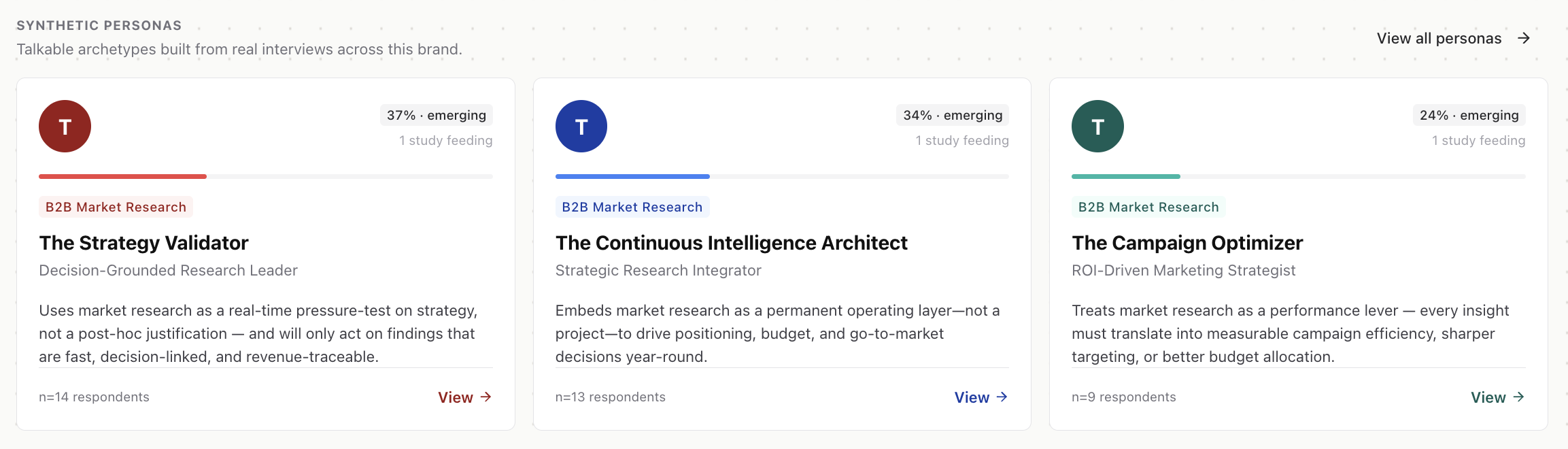
Synthetic Personas are talkable archetypes Gather builds from your completed research — the real people who have actually answered your interviews, grouped into a handful of distinct behavioral patterns. Each persona is a composite of respondents who think and act alike, grounded entirely in their own words. They give you a fast, durable way to understand "who keeps showing up in our research" and to pressure-test ideas against those patterns without fielding a brand-new study every time.
Grounded in real responses, not invented. Synthetic Personas are different from Synthetic Research (an audience type that generates AI respondents to pressure-test a study before you field it). Personas are built after the fact, from actual completed conversations — every trait, behavior, and claim traces back to something a real respondent said.
When personas appear
Personas only show up once you've collected enough real data. They surface in two places: on your dashboard, in the Synthetic Personas section (a preview of your top archetypes), and on the dedicated Brand archetypes page, which you open with View all personas. As you run more studies, Gather has more responses to learn from, so personas get sharper and their confidence grows. If you don't see personas yet, you simply need more completed research feeding the brand.
Reading the personas list
Each archetype on the Brand archetypes page shows an at-a-glance summary:
Name and descriptor — for example, "The Strategy Validator · Decision-Grounded Research Leader."
Share of base — the percentage of your researched audience this pattern represents.
Maturity — how established the pattern is (for example, emerging).
Studies feeding it — how many completed projects contribute to the persona.
A one-line signature — the single behavior that most defines the archetype.
Respondent count (n=) — how many real respondents sit behind the persona.
Click View on any card to open the full persona.
Inside a persona
A persona detail page is a complete portrait of the archetype, all of it traceable to real responses:
Signature insight — the one thing most likely to change how you act toward this group.
Overview — a narrative summary of who they are and how they behave.
What sets this persona apart — how this archetype differs from its siblings, so you don't treat distinct groups the same way.
Traits, Behaviors, Objections, and Motivators — the detailed make-up of the persona: what's true of them, what they do, what holds them back, and what drives them.
Strategic implications — concrete recommendations for how to message, position, and sell to this group.
Underlying signal — the language pattern behind the cluster, including the distinguishing terms respondents in this group use most.
Talking to a persona
Every persona is talkable. The Talking to [persona] panel is a grounded chat: ask the archetype a question and it answers in character, drawing only on this persona's snapshot and its cited responses (look for the Grounded label). It's a way to gut-check ideas against the pattern — try prompts like "What messaging resonates most?", "What would make you switch?", "What do we say that feels off?", "How do you evaluate competitors?", or "What proof points actually move you?" Because answers stay grounded in real responses, the persona won't make things up beyond what the research supports.
How to trust a persona: confidence, intervals, and grounding
Gather is transparent about how solid each archetype is so you can weigh it appropriately:
Confidence score — a 0–100 score with a plain-language label (low / medium / high) and a ceiling the persona can reach as more data comes in.
Confidence interval — the persona's share of base shown with a 95% CI range. The wider the range, the less settled the estimate. Each new study narrows the interval.
Reliability threshold — personas grow more reliable as the respondent count climbs; Gather flags a target (n ≥ 50) for highly reliable responses.
Cluster stability — how consistently this group holds together as a distinct pattern.
Grounding — whether the persona is backed only by your studies or also reinforced by public data.
A small, early persona with a wide interval is still useful as a directional signal — just treat it as a hypothesis to validate, not a settled fact.
Feeding studies and grounded claims
Two sections show exactly where a persona comes from. Feeding studies lists the completed projects that contribute respondents to this archetype. Grounded claims lists the response-backed statements behind the persona — every claim is something the underlying respondents actually expressed, so you can trace any trait back to evidence.
Regenerating personas
As you collect more research, you can refresh your archetypes with Regenerate personas on the Brand archetypes page. Gather re-clusters your latest responses, which can sharpen existing personas, tighten their confidence intervals, or surface new patterns that have emerged since the last run.